
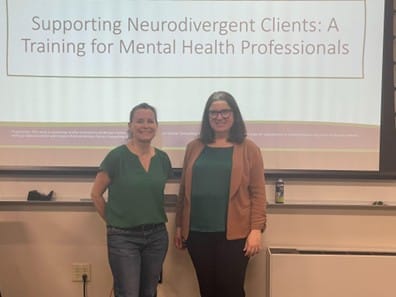
Pictured L-R: Dana Hopkins of Dutchess County Department of Mental Health and Jennifer A. Brager, MA, BCBA, LBA, Behavior Analyst with Anderson Center Consulting and Training
Regardless of age, background, or circumstances, there’s no question that a therapeutic journey can be transformative, healing, and empowering.
And most people will agree that what drives success is a client-patient relationship that is deeply rooted in trust, empathy, and nonjudgement – particularly for those with a diagnosis of autism or another neurodiversity.
Yet, there is another dimension which leads to optimal outcomes, which is a therapist’s knowledge of developmental disabilities, and his/her mastery of the evidence-informed tools that can make autistic and neurodivergent individuals truly feel seen, heard, and understood. Unfortunately, that piece is not always embedded into a Bachelor’s, Master’s, or even Ph.D. psychology/counseling degree curriculum. So, where does one acquire insights specific to this population?
Enter Anderson Center Consulting and Training (ACCT).
Since 2007, ACCT (an affiliate of Anderson Center for Autism) has empowered businesses, organizations, schools/colleges, hospitals, government agencies, first responders, families, caregivers, and more with training designed to help enhance the quality of life for autistic and neurodivergent people in their circles.
What had long been missing from ACCT’s roster, though, was a training tailored to counselors, social workers, and therapists. To bridge that gap, the team developed a highly-anticipated program that charts a new course: “Supporting Neurodivergent Clients: A Training for Mental Health Professionals.”
And thanks to the support of Dutchess County Department of Health, ACCT is pleased to announce that their inaugural training event, held in May of 2026, was a smash success. The program attracted 25 mental health professionals who learned how to enhance communication, foster collaboration, and strengthen relationships with the autistic or neurodivergent individuals they serve in counseling or therapeutic settings.
Jennifer Brager, MA, BCBA, LBA, Behavior Analyst with Anderson Center Consulting and Training, reflected: “On a regular basis, I work with families expressing a desperate need for access to mental health professionals who truly understand autism and neurodiversity. In the past, we’ve seen a scarcity of providers trained to appropriately support the needs out there, which has been devastating for so many. But with this training developed, I now feel hopeful and excited about the possibilities that lie ahead for all who are in need of this more specialized mental health care.”
Brager continued, “We are beyond grateful to Dutchess County for being the first to engage ACCT for the purpose of building capacity to this end; they clearly value efforts to enlighten mental health professionals about the ways autism, neurodiversity, sensory processing, masking, and the counseling relationship itself can impact outcomes. Our goal was to shed light on how to most effectively address trauma, navigate executive function challenges, and build a sense of emotional safety so that the trainees, who work with autistic and neurodivergent individuals, have the expertise needed to improve service delivery and more confidently and effectively work with this population.”
The results, she noted, were overwhelmingly positive.
Noted Dana M. Hopkins, LCSW-R, All Abilities Program Director at Dutchess County Department of Mental Health, “The training created a lot of robust discussions covering an array of topics: signs of autism, co-occurring mental health conditions, statistics on autism, tips on how to work with individuals who have autism, service systems, and more. My hope is that the mental health professionals that were in the room walked away recognizing that they don’t have to re-create modalities of therapy, but that they just sometimes need to think out of the box like they would for other individuals they work with.”
Added Shannon Winslow, LMSW, Behavioral Health Clinician at Together for Youth, “My primary field of work is trauma focused, so I’m limited on how I can effectively treat my neurodiverse clients and support their families. The facilitators were extremely knowledgeable, helped me understand my clients better, and have been amazing in connecting me to dozens of resources that will meet the needs of my clients when I can’t.”
The team at ACCT expects a trajectory of growth for this newly-minted mental health professional training program, and is enthusiastic about the meaningful contributions they can make.
Noted Kathleen Marshall, Director of Program Services for Anderson Center Consulting and Training, “Autistic and neurodivergent individuals often deal with intense feelings of loneliness, isolation, stress, and anxiety, but therapy can help address and resolve those issues. By giving mental health professionals proficiency in this area, we have the chance to make dramatic differences in the well-being of so many people here and all over the world.”
Marshall explained that because ACCT offers both in-person and virtual training options, these high-in-demand competencies can and should be developed, no matter where someone lives. “Incidence rates are growing exponentially; we must do all we can to ensure that we’re addressing mental health needs for this population. The time required to learn this material through our team at ACCT is minimal, but the ways it can make a difference are more significant than anyone can imagine.”
To learn more about training opportunities like this one and/or to pursue designation as “Autism Informed” or “Autism Supportive” through Anderson Center Consulting and Training, visit andersoncenterconsultingandtraining.org